
Close Menu
Beverly Hills Examiner

    Subscribe to Updates

    Get the latest creative news from FooBar about art, design and business.

    What's Hot

    Woman Got Stuck In A Mud Hole At Lollapalooza + We Talked to Her

    August 5, 2026

    Trump claims — yet again — that a deal to reopen Hormuz is close

    August 5, 2026

    Senate Republicans Ignore Trump And Let SAVE America Act Die

    August 5, 2026
    Facebook X (Twitter) Instagram
    Beverly Hills Examiner
    • Home
    • US News
    • Politics
    • Business
    • Science
    • Technology
    • Lifestyle
    • Music
    • Television
    • Film
    • Books
    • Contact
      • About
      • Amazon Disclaimer
      • DMCA / Copyrights Disclaimer
      • Terms and Conditions
      • Privacy Policy
    Beverly Hills Examiner
    Home»Science»Second Private U.S. Moon Lander Readies for Launch
    Science

    Second Private U.S. Moon Lander Readies for Launch

    By AdminFebruary 12, 2024
    Facebook Twitter Pinterest LinkedIn WhatsApp Email Reddit Telegram
    Second Private U.S. Moon Lander Readies for Launch


    Second Private U.S. Moon Lander Readies for Launch

    In the ancient Greek epic the Odyssey, Ithacan king Odysseus doggedly sails through treacherous waters to get back home. As soon as this Valentine’s Day, a spacecraft of the same name will attempt a dangerous journey of its own: the first U.S. soft landing on the moon since 1972.

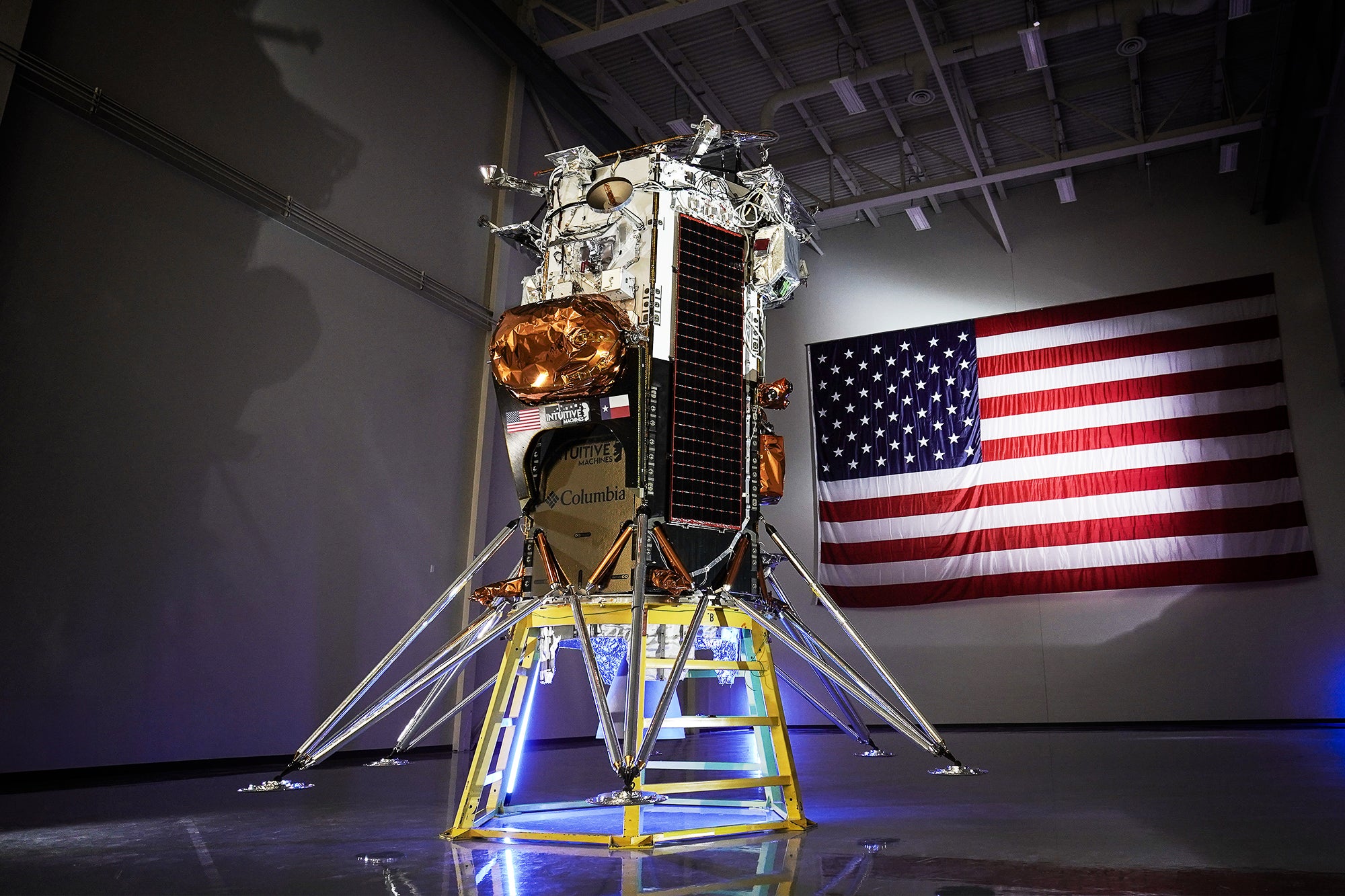
    As soon as 12:57 A.M. EST on February 14, a 14-foot-tall moon lander built by the Houston-based company Intuitive Machines will launch atop a SpaceX Falcon 9 rocket. That spacecraft, nicknamed Odie—short for Odysseus—will be carrying payloads ranging from NASA science instruments to a group of sculptures by artist Jeff Koons. Odie’s destination: a crater less than 200 miles from the lunar south pole.

    This mission, named IM-1, is flying under NASA’s Commercial Lunar Payload Services (CLPS) initiative, which encourages private companies to take over the delivery of supplies and scientific instruments to the moon. Intuitive Machines is one of several companies angling to be the first private firm to ever softly land a spacecraft on another celestial body.


    On supporting science journalism

    If you’re enjoying this article, consider supporting our award-winning journalism by subscribing. By purchasing a subscription you are helping to ensure the future of impactful stories about the discoveries and ideas shaping our world today.


    “We understand and welcome the responsibility of our IM-1 mission,” said Intuitive Machines’ vice president of space systems Trent Martin in a January 31 media briefing. “The hopes and dreams of our customers, employees, their families, our shareholders and the lunar operations of the entire country are encapsulated and ready for launch.”

    The mission marks a major test for CLPS, which will pay out as much as $2.6 billion to private companies for lunar deliveries. NASA hopes to save substantial money through the program. In 2019 Intuitive Machines received a NASA contract for IM-1 that is now worth $118 million. That’s less than the agency historically would have spent to build its own lunar lander.

    NASA also hopes that CLPS will increase the frequency of robotic moon missions. IM-1 will be the second CLPS mission to launch, following Astrobotic’s Peregrine mission in January, and up to four more CLPS missions will do so by the end of the year. “The promise of the high cadence is really what’s compelling,” says Michelle Munk, acting chief architect of NASA’s Space Technology Mission Directorate. “The ability to have a payload, improve upon it and fly it again, all within the span of a couple of years, is really a very unique opportunity.”

    But in exchange for lower costs and faster turnaround times, NASA is letting private companies design and operate their own lunar landers, and the agency is taking on a higher risk of any one CLPS mission failing. Historically, only about five out of every nine attempted moon missions have succeeded. No commercial spacecraft has safely landed on another celestial body yet.

    Last month the Pittsburgh-based company Astrobotic launched its Peregrine moon lander with an assortment of NASA and non-NASA payloads, only for the spacecraft to suffer a critical anomaly soon after launch. Though Peregrine survived in space for a week and a half, it had leaked too much fuel to attempt a moon landing. Instead Astrobotic disposed of the spacecraft by making it reenter and burn up in Earth’s atmosphere.

    “What we’ve asked industry to do—which is to soft-land and operate on the moon’s surface—is not easy at all. It’s extremely difficult,” said Joel Kearns, a deputy associate administrator for exploration at NASA’s Science Mission Directorate, in the January 31 media briefing.

    Even lunar landers built by national space agencies have hit obstacles. On January 19 SLIM—a lander built by the Japanese Aerospace Exploration Agency (JAXA)—reached the moon’s surface intact and successfully deployed two rovers, making Japan just the fifth country to soft-land on the moon’s surface. SLIM touched down at an angle that initially prevented sunlight from reaching its solar panels, however, which limited its available power. SLIM entered a dormant state on January 31, ahead of two weeks of dark, brutally cold lunar night.

    Scouting Out the Lunar South Pole

    At NASA’s request, IM-1 is targeting a landing site at Malapert A, a crater nestled in the moon’s south polar region that is close to a proposed landing site for NASA’s Artemis III mission. If Odie touches down successfully, IM-1 will mark just the second soft landing in the moon’s south polar region, following India’s Chandrayaan-3 mission.

    Odie will be the first version of Intuitive Machines’ Nova-C class of lunar landers to launch. These landers are designed to carry up to 130 kilograms (287 pounds) of payload to the lunar surface. IM-1 will deliver six payloads on behalf of NASA, as well as an assortment of private payloads.

    One of the NASA payloads onboard, called SCALPSS (Stereo Cameras for Lunar Plume Surface Studies), promises to deliver some of the best data of their kind since Apollo. It consists of four cameras that ring the bottom of the lander and will image the vehicle’s exhaust plume as it interacts with the lunar surface during descent. After landing, SCALPSS will take two-dimensional and three-dimensional images of most of the area beneath Odie to map the crater carved out by the rocket plume. Images from SCALPSS should help inform simulations of scaled-up moon landings, such as those planned for NASA’s Artemis program.

    “As we start to emplace more and more vehicles on the surface of the moon, we really want to understand how close together they can land and what kind of protection landers themselves or assets may need going forward,” says Munk, who is also SCALPSS’s principal investigator.

    As SCALPSS looks at Odie’s touchdown from below, an ambitious student-built payload will be looking at Odie from off to the side. EagleCam, built by a 26-student team at Embry-Riddle Aeronautical University, is a small CubeSat that will eject from Odie when the lander is 30 meters (100 feet) above the lunar surface. The CubeSat will then free-fall and smack into the lunar surface at about 10 meters per second (22 miles per hour).

    No matter how the fallen CubeSat is oriented after landing, the Embry-Riddle team hopes that at least one of three wide-angle cameras onboard will capture a view of Odie touching down some 10 to 12 meters (33 to 39 feet) away.

    EagleCam hopes to capture a 360-degree view from the moon—including the first third-person images ever taken of a spacecraft landing on another celestial body. EagleCam is also aiming to perform the first lunar demonstrations of Wi-Fi and an electric lens-cleaning technology.

    “We’re almost getting to closure on this project—we’re almost tasting the science,” says Daniel Posada, a Ph.D. candidate at Embry-Riddle and EagleCam’s lead engineer. “But at the same time, we know the moon is harsh.”

    Other payloads point to the Wild West future of commercial space: where marketing and technical partnerships will bleed into each other during the development of new spacecraft.

    To help control the lander’s internal temperature, some of Odie’s body panels are covered in Omni-Heat Infinity, an aluminum-dotted polyester developed by Columbia Sportswear for its jacket linings. Omni-Heat was originally inspired by the thin, metallic “space blankets” that NASA has used since the 1960s to insulate spacecraft. To fly Omni-Heat Infinity onboard Odie, Columbia and Intuitive Machines had to check that both the material and the glue used to adhere it could withstand extreme temperature ranges and the vacuum of space.

    “If it weren’t for this program [CLPS], it’s not clear to me that there would be an avenue for companies like Columbia to jump in and help out,” says Haskell Beckham, Columbia’s vice president of innovation. “We’ve learned stuff that’s come back and helped us do what we do.”


    Original Source Link

    Share. Facebook Twitter Pinterest LinkedIn WhatsApp Email Reddit Telegram
    Previous ArticleWatch the ‘Kingdom of the Planet of the Apes’ Trailer Super Bowl Spot – The Hollywood Reporter
    Next Article Peak XV takes startups on a Silicon Valley trip in AI push

    RELATED POSTS

    Gene-Edited Puppies Will Melt Your Heart—but Won’t Trigger Your Allergies

    August 5, 2026

    Wormholes could be the key to time travel

    August 5, 2026

    How Data Centers Broke American Politics

    August 4, 2026

    The U.S. military needs tungsten, but pristine NASA site may stand in the way

    August 4, 2026

    There Are 2 Eclipses This August. Here’s How to See Them

    August 3, 2026

    Eating less protein could help you live longer

    August 3, 2026
    latest posts

    Woman Got Stuck In A Mud Hole At Lollapalooza + We Talked to Her

    We now know how a Lollapalooza attendee who became stuck in a mudpit up to her…

    Trump claims — yet again — that a deal to reopen Hormuz is close

    August 5, 2026

    Senate Republicans Ignore Trump And Let SAVE America Act Die

    August 5, 2026

    Perez Hilton’s apparent self-harm video prompts involuntary psych hold: source

    August 5, 2026

    Trump EPA wrongly canceled $20B in climate funds, appeals court rules

    August 5, 2026

    Gene-Edited Puppies Will Melt Your Heart—but Won’t Trigger Your Allergies

    August 5, 2026

    Netflix’s Upcoming Stranger Things Replacement Could Last Forever

    August 5, 2026
    Categories
    • Books (1,407)
    • Business (6,311)
    • Cover Story (9)
    • Film (6,250)
    • Lifestyle (4,310)
    • Music (6,321)
    • Politics (6,293)
    • Science (5,660)
    • Technology (6,245)
    • Television (5,941)
    • Uncategorized (3)
    • US News (6,296)
    popular posts

    Chuck Schumer Moves To Isolate MAGA Republicans

    Senate Majority Leader Chuck Schumer (D-NY) made it clear during a press conference that he…

    U.S. crypto czar’s $200 million portfolio held Bitcoin, Coinbase, and Robinhood

    March 15, 2025

    For King & Country Takes Top Honors at 2022 K-Love Fan Awards – Billboard

    June 4, 2022

    Inflation Drags Eurozone Economy Into Recession

    June 8, 2023
    Archives
    Browse By Category
    • Books (1,407)
    • Business (6,311)
    • Cover Story (9)
    • Film (6,250)
    • Lifestyle (4,310)
    • Music (6,321)
    • Politics (6,293)
    • Science (5,660)
    • Technology (6,245)
    • Television (5,941)
    • Uncategorized (3)
    • US News (6,296)
    About Us

    We are a creativity led international team with a digital soul. Our work is a custom built by the storytellers and strategists with a flair for exploiting the latest advancements in media and technology.

    Most of all, we stand behind our ideas and believe in creativity as the most powerful force in business.

    What makes us Different

    We care. We collaborate. We do great work. And we do it with a smile, because we’re pretty damn excited to do what we do. If you would like details on what else we can do visit out Contact page.

    Our Picks

    Gene-Edited Puppies Will Melt Your Heart—but Won’t Trigger Your Allergies

    August 5, 2026

    Netflix’s Upcoming Stranger Things Replacement Could Last Forever

    August 5, 2026

    His Hospitalization, Past Illness, Surgery, and More

    August 5, 2026
    © 2026 Beverly Hills Examiner. All rights reserved. All articles, images, product names, logos, and brands are property of their respective owners. All company, product and service names used in this website are for identification purposes only. Use of these names, logos, and brands does not imply endorsement unless specified. By using this site, you agree to the Terms & Conditions and Privacy Policy.

    Type above and press Enter to search. Press Esc to cancel.

    We use cookies on our website to give you the most relevant experience by remembering your preferences and repeat visits. By clicking “Accept All”, you consent to the use of ALL the cookies. However, you may visit "Cookie Settings" to provide a controlled consent.
    Cookie SettingsAccept All
    Manage consent

    Privacy Overview

    This website uses cookies to improve your experience while you navigate through the website. Out of these, the cookies that are categorized as necessary are stored on your browser as they are essential for the working of basic functionalities of the website. We also use third-party cookies that help us analyze and understand how you use this website. These cookies will be stored in your browser only with your consent. You also have the option to opt-out of these cookies. But opting out of some of these cookies may affect your browsing experience.
    Necessary
    Always Enabled
    Necessary cookies are absolutely essential for the website to function properly. These cookies ensure basic functionalities and security features of the website, anonymously.
    CookieDurationDescription
    cookielawinfo-checkbox-analytics11 monthsThis cookie is set by GDPR Cookie Consent plugin. The cookie is used to store the user consent for the cookies in the category "Analytics".
    cookielawinfo-checkbox-functional11 monthsThe cookie is set by GDPR cookie consent to record the user consent for the cookies in the category "Functional".
    cookielawinfo-checkbox-necessary11 monthsThis cookie is set by GDPR Cookie Consent plugin. The cookies is used to store the user consent for the cookies in the category "Necessary".
    cookielawinfo-checkbox-others11 monthsThis cookie is set by GDPR Cookie Consent plugin. The cookie is used to store the user consent for the cookies in the category "Other.
    cookielawinfo-checkbox-performance11 monthsThis cookie is set by GDPR Cookie Consent plugin. The cookie is used to store the user consent for the cookies in the category "Performance".
    viewed_cookie_policy11 monthsThe cookie is set by the GDPR Cookie Consent plugin and is used to store whether or not user has consented to the use of cookies. It does not store any personal data.
    Functional
    Functional cookies help to perform certain functionalities like sharing the content of the website on social media platforms, collect feedbacks, and other third-party features.
    Performance
    Performance cookies are used to understand and analyze the key performance indexes of the website which helps in delivering a better user experience for the visitors.
    Analytics
    Analytical cookies are used to understand how visitors interact with the website. These cookies help provide information on metrics the number of visitors, bounce rate, traffic source, etc.
    Advertisement
    Advertisement cookies are used to provide visitors with relevant ads and marketing campaigns. These cookies track visitors across websites and collect information to provide customized ads.
    Others
    Other uncategorized cookies are those that are being analyzed and have not been classified into a category as yet.
    SAVE & ACCEPT