
A few weeks ago, I arrived hungry to the Brooklyn Navy Yard in New York City, ready for a unique culinary experience. Finalists of NASA and the Canadian Space Agency’s Deep Space Food Challenge had come from all across the planet to demonstrate how future astronauts might grow their own food. I descended upon a tiny cup of chocolate mousse topped with a raspberry.
“The challenge in space is: you can’t take a cow or a chicken with you,” said Koruna Rawal, chief marketing officer at Nature’s Fynd—a Chicago-based company that develops microbe-based proteins and has a finalist team in the competition—as I ate the mousse, which was made from microscopic fungi. (The raspberry was just a raspberry.) I expected it to taste like grainy, bland protein powder, but it was smooth and rich. Unsated, I moved on to fungi-based “meatballs” in tomato sauce, which were as meatlike as any meat substitute I’ve had.
Chances are, for most people, the term “space food” brings to mind chalky, crumbly “astronaut ice cream,” which is actually mostly a myth. Crumbly foods are a big no-no in astronautics because bits adrift in microgravity can wreak untold havoc on delicate spacecraft components. Visitors to the International Space Station typically eat sturdier, nonperishable stuff from vacuum-sealed packages. Back in the day, Apollo-era astronauts dined on freeze-dried, cube-shaped delicacies such as shrimp cocktail and date fruitcake. Some of these were, apparently, appetizing. “Happiness is bacon squares for breakfast,” proclaimed Apollo 8 crew member Jim Lovell while midway to the moon in 1968.
But venturing to Mars or beyond probably demands a completely different approach. Without a steady (and extremely costly) stream of supply shipments, in-space habitats and otherworldly outposts of the future will need to serve as highly engineered, self-contained ecosystems that grow satisfying and healthy food.
That’s what the Deep Space Food Challenge, launched in 2021, is all about. This year 11 U.S. teams and six international teams with bold ideas for miniaturizing the circle of life moved from a conceptual Phase 1 to a developmental Phase 2, where they built and demonstrated “kitchen-scale” prototypes of their high-tech agricultural inventions. Additionally, 12 more U.S. teams and two international teams joined the competition in Phase 2. The eight Phase 2 winners, crowned at the May event in Brooklyn, will move on to crafting “full-scale” demonstrations in Phase 3. The U.S.-based teams received a check for $150,000.
“If we are realistic about becoming a multiplanetary species, we have to learn how to reduce or cut the umbilical cord that connects us to Earth,” says Pablo de León, team lead of one of the Phase 2 winners: Kernel Deltech, the space-oriented division of the company Eternal Bioworks. The Florida-based team brought a cast-iron skillet to fry up slices of faux cheese, which accompanied faux burger bites. Both foods were made from a species of protein-heavy fungus called Fusarium venenatum.
This fungus has a decades-long history of human consumption and is also used by the meat substitute brand Quorn. The Kernel Deltech team developed compact bioreactors that can grow and harvest the fungi in microgravity with very limited resources. The result is a gray, protein-packed powder. Its visual transformation into burgerlike and cheeselike bites was impressive, but the burger was tasteless and mushy, and the cheese was artificial and slimy. I’d say it had “room for improvement.”
Fungi were the clear winner of the day, to the surprise of Ralph Fritsche, senior project manager of NASA’s Space Crop Production. Up to this point, he says, most space food research has focused on plants. “So that’s kind of like a wake-up call for me” to further probe the possibilities of fungi, Fritsche says. These are “very versatile organism[s] that can utilize many different sources as substrate to grow on,” says Kristina Karlsson, a member of international finalist team Mycorena from Gothenburg, Sweden. Mycorena’s system grows fungi by feeding them microalgae nourished by fungi-sourced CO2.
Solar Foods, an international team from Lappeenranta, Finland, took a different approach for their protein-heavy powder: bacteria. Arttu Luukanen, the team’s representative at the event, offered me a bright yellow fortune cookie made from the powder. Solar Foods uses safe-to-eat microbes that can metabolize hydrogen gas in order to grow. Hydrogen is readily available on spacecraft as a by-product of standard life-support systems that produce breathable oxygen by using electrolysis to split apart water molecules. The leftover hydrogen is often discarded, Luukanen says, but Solar Foods’ system instead repurposes the gas in order to grow its microbe-based protein.
The result is a bright yellow powder called Solein that looks like turmeric, contains all the essential amino acids and can be readily incorporated into practically any dish. The Solein-based fortune cookie was extremely hard to chew, though I give it some grace because it probably traveled all the way from Finland. “I’ve tried their Solein in a variety of foods, and it was excellent,” NASA’s Fritsche says.
Other finalists rely on a space habitat’s hydrogen, too. Air Company, a Brooklyn-based firm that turns captured CO2 into sustainable jet fuel, uses hydrogen—and CO2, which, in practice, would come from astronauts’ breath—to create ethanol, the buzz-inducing alcohol in beverages. (One buzzkill: the ethanol is then used to feed and grow nutritional yeast, not to make drinks.) “The way that I see it is that our technology can provide the bottom of the food pyramid, the base,” says Stafford Sheehan, Air Company’s co-founder.
For some dietary diversity, other teams have their sights set on using larger, macroscopic organisms. Nolux, a team of researchers from the University of California, Riverside, and the University of Delaware, has developed a method of artificial photosynthesis that can grow oyster mushrooms without sunlight. Their method, published in Nature Foods, uses electrolysis to convert exhaled CO2 and water into oxygen and acetate. The acetate is then pumped into a growing chamber to feed the mushrooms, which can plump up in the dark in a matter of weeks. The process also works on algae and yeast and is more efficient than photosynthesis at converting energy into biomass.
“The beauty of the system is really how efficient it is,” says Nolux team member Marcus Harland-Dunaway. The team is now working on genetically modifying more traditional crops to take up energy from this alternative source, he says.
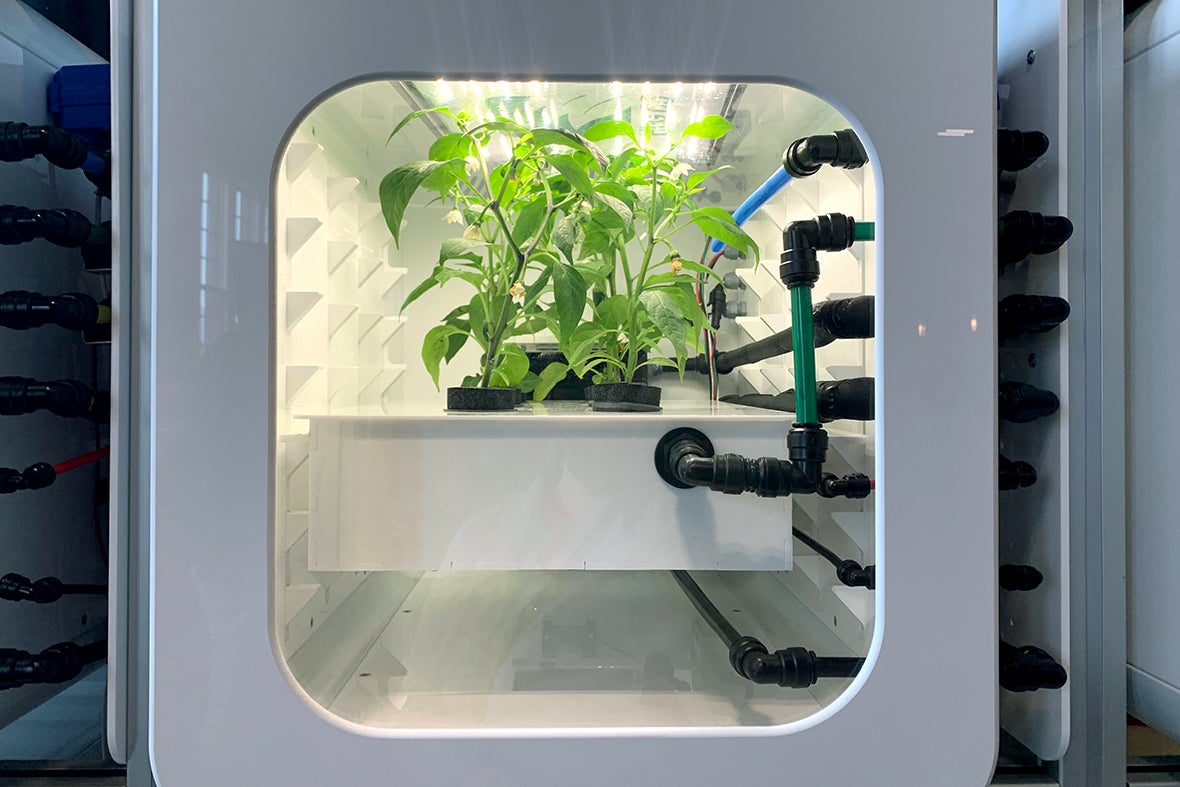
The most visually impressive presentation belonged to Interstellar Lab, based in Florida, which has developed a system that can grow plants, mushrooms and insects—each in its own small cube. “That’s a big deal,” says Nolux team member Andrés Narvaez of Interstellar Lab’s modular display. The compartmentalized growing cubes would allow astronaut farmers to individually control each cube’s ambient conditions. The team showcased massive mushrooms, leafy greens and black soldier fly larvae that “self-harvest” by tumbling down a ramp (a process that would need to be revised to work in microgravity), where they are collected and pulverized into a protein-rich powder. Fortunately for me, the team didn’t offer any samples of the larvae, but it did offer some tasty microgreens.
Enigma of the Cosmos, a team from the company GAIA Project Australia, also developed a compact, high-tech system for growing leafy greens. Its system, only two square meters (21.5 square feet) in size, can produce up to 1.6 pounds of leafy greens and microgreens per day, according to a press release.
Lastly, I visited the odd winner out: Ascent Technologies, the only team to tackle the problem of cooking food safely in microgravity. Its system is called SATED (Safe Appliance, Tidy, Efficient and Delicious), a food processor–sized centrifugal oven that cooks as it spins. At the event, SATED served up a cylindrical pizza—arguably more of a stromboli or perhaps even a calzone—with the cheese and toppings facing inward. And in no small part because it was really just a regular, down-to-Earth pizza, it was indeed delicious.
“It’s all temperature-controlled, super safe—no way to mess up cooking, no way to create smoke or even burn your food here,” said Jim Sears, founder of Ascent Technologies, during a livestream of the event.
Astronauts aren’t the only ones who could benefit from these innovations because the teams were also required to consider how their inventions can help feed humans here on Earth. The United Nations’ Food and Agriculture Organization estimates that food production must increase 60 percent by 2050 to feed a population of nearly 10 billion. At the same time, climate change will continue to threaten staple crops around the world, causing global food insecurity. Plus, the current food system contributes 20 to 40 percent of all greenhouse gas emissions. These innovations, designed to work in the resource-limited void of space, could also feed the growing population of Earth more sustainably and address food insecurity in inhospitable climates.
“Every one of [these technologies] aims for sustainability,” Fritsche says. “I think that’s part of the beauty.”
Phase 2 of the competition exceeded Fritsche’s expectations, he says. “I was sitting there during the meeting, thinking, ‘Well, what are we going to ask these people to do for Phase 3?’” The logical next step is to test the durability and long-term safety of the designs, he says.
Eventually the food will also need to be appealing to astronauts. “If astronauts don’t like something that’s provided to them, over the long haul, they’re just not going to eat it,” Fritsche says. Protein powders, whether they’re made from fungi, larvae or nutritional yeast, will need to be transformed in a spacecraft’s galley into appealing food in order to satisfy any crew’s physical and psychological hunger for a good meal.
Let’s hope, for the sake of all future astronauts, that someone at least figures out how to turn any of these feedstocks into delicious faux bacon squares.