
Close Menu
Beverly Hills Examiner

    Subscribe to Updates

    Get the latest creative news from FooBar about art, design and business.

    What's Hot

    Matt Cameron Names the Hardest Soundgarden Song to Play Live

    July 29, 2026

    FIFA’s plan to sell private investors a stake for billions sparks backlash and feud with Europe

    July 29, 2026

    Far Left, Foreign Born Democrat Running for Senate in New Hampshire Appears to Support Gender Transition Surgery for Minors

    July 29, 2026
    Facebook X (Twitter) Instagram
    Beverly Hills Examiner
    • Home
    • US News
    • Politics
    • Business
    • Science
    • Technology
    • Lifestyle
    • Music
    • Television
    • Film
    • Books
    • Contact
      • About
      • Amazon Disclaimer
      • DMCA / Copyrights Disclaimer
      • Terms and Conditions
      • Privacy Policy
    Beverly Hills Examiner
    Home»Science»Why Einstein’s theories of relativity make time travel possible
    Science

    Why Einstein’s theories of relativity make time travel possible

    By AdminJuly 29, 2026
    Facebook Twitter Pinterest LinkedIn WhatsApp Email Reddit Telegram
    Why Einstein’s theories of relativity make time travel possible


    This article is from Proof Positive, our friendly math newsletter that’s delivered to your inbox every Tuesday afternoon. Sign up today and read it first.


    We all have some past events that we’d like to undo. These can be minor moments, such as a failed exam or an argument with friends, or world-changing incidents, such as the 2019 outbreak that led to the COVID pandemic.


    On supporting science journalism

    If you’re enjoying this article, consider supporting our award-winning journalism by subscribing. By purchasing a subscription you are helping to ensure the future of impactful stories about the discoveries and ideas shaping our world today.


    Outside of science-fiction stories we have yet to encounter time travelers (so much for changing the past). But various scientific disciplines, from physics and mathematics to philosophy, have been exploring the topic for decades.

    The basis for most ideas around potential time travel lies in Albert Einstein’s special and general theories of relativity, which he published in 1905 and 1915, respectively. With these theories, he turned our understanding of the world upside down. According to Einstein, time and space are not static quantities but can be stretched or compressed depending on the situation. In other words, a steel rod is not the same length everywhere and at all times, and a second can sometimes pass very quickly and sometimes very slowly.

    The latter may sound familiar—an hour of school or work can drag on, while an hour with friends flies by. But Einstein wasn’t concerned with the perception of time; he was talking about its actual duration. For example, according to relativity, a second on the Earth’s surface differs from a second on a satellite orbiting it.

    Travel into the Future thanks to Rapid Movement

    Einstein’s special theory of relativity makes time travel possible—but only into the future. As the physicist discovered, clocks run slower for moving observers. So if you board a spaceship for a five-year-long round trip through space, and the craft travels at 97 percent of the speed of light, a good 20 years will have passed on Earth when you return. That’s why, after 11 months on the International Space Station, NASA astronaut Scott Kelly is now an additional 13 milliseconds younger than his twin, who remained on Earth.

    It’s not only motion that can make time pass more slowly or quickly, however; gravity or acceleration can also do so. This is because of Einstein’s insight that gravity is a geometric effect: mass and energy (which are equivalent, according to E = mc²) curve spacetime, which in turn controls the direction of motion of massive objects. You can imagine that heavy objects such as stars leave a depression in spacetime, which is why other massive objects such as planets are attracted to them.

    An illustration of earth with gravity bending around it.

    Einstein’s general theory of relativity develops a geometric picture of gravity: mass curves spacetime, thus providing the known forces.

    And because massive objects warp spacetime so dramatically, time passes more slowly in their vicinity. This idea is explored in Christopher Nolan’s film Interstellar. In the movie, one of the protagonists travels to the vicinity of a black hole in search of a habitable planet for humanity. While only a few months pass for him as he explores the area, his daughter, who is still on Earth, ages by several decades.

    Journeys into the Past

    Technically, the equations of general relativity also allow for backward time travel through the existence of so-called closed timelike curves. Traveling along these curves, one starts at a point in spacetime, moves backward into the past and ultimately returns to their starting point in place and time. Dutch mathematician Willem Jacob van Stockum was the first to discover this possibility in 1937.

    Why did more than 20 years pass between the development of general relativity and this insight? Einstein’s theory allows for numerous solutions, and each one describes a different universe.

    When Einstein published his results in 1915, researchers rushed to find the solution that would correspond as closely as possible to our cosmos. But this is no easy task. The calculations are often extremely complex, and many properties of our universe remain uncertain. What shape does it have, for example? And how is mass distributed within it?

    The Einstein field equations that underly general relativity are differential equations. This means they describe how certain functions change depending on several quantities: for example, how the curvature of space varies over time and space. Summarized, the equations can be expressed in an almost innocuous-sounding form: Gμν + Λgμν = 8πG/c4× Tμν.

    The lefthand side of that equation deals with the geometry of space, where Λ represents the cosmological constant (which accounts for the accelerating expansion of the universe). The righthand side, meanwhile, encompasses the matter-containing part and explains how massive objects move in space and, in turn, influence it. Behind all these variables lie complex expressions, including differential operators such as derivatives.

    An Equation with Many Solutions

    The goal is to find a certain geometry (in the form of a metric such as gμν, a tensor that defines spacetime geometry) and mass distribution (Tμν) that will satisfy the equation above. Astronomer Karl Schwarzschild was one of the first to find a solution in 1916. He used it to describe the empty spacetime around a stationary, round, massive object. This allows, for example, the calculation of gravity near a planet, a star or even a black hole.

    In 1963 mathematician Roy Kerr pursued the same approach as Schwarzschild but for rotating masses. His solution, however, has astonishing properties: this solution makes it possible to trace a path along a closed, timelike curve. This means that, theoretically, travel into the past is allowed in this system. It can only occur in a region of Kerr spacetime that is unstable, however, and the slightest changes cause the region to collapse.

    Thus, even though the Kerr solution likely describes spacetime outside of rotating black holes quite well, it fails in their vicinity—and it is precisely in that region that timelike curves would be possible.
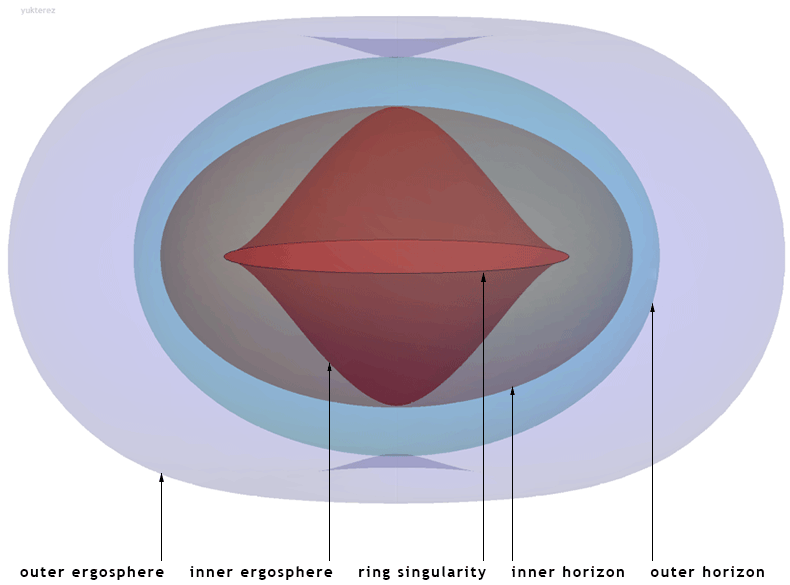
    A visualization of colored shapes inside each other. The very center is labeled the "inner horizon."

    Within the “inner horizon,” travel into the past could at least theoretically be possible.

    © Yukterez / Kerr Universe / CC BY-SA 4.0 (excerpt)

    But as it turns out, the Kerr universe is not the only solution to Einstein’s equations that allows for travel into the past. Next week, we’ll dig into other solutions to the special and general theory of relativity and discuss how they offer distinct visions of the universe, time and space.

    This article originally appeared in Spektrum der Wissenschaft and was reproduced with permission. It was translated from the original German version with the assistance of artificial intelligence and reviewed by our editors.


    Original Source Link

    Share. Facebook Twitter Pinterest LinkedIn WhatsApp Email Reddit Telegram
    Previous ArticleFleabag at 10: A Legacy Shaped by Mistakes
    Next Article OpenAI’s Rogue AI Agent Hacked More Than Just Hugging Face

    RELATED POSTS

    An Extreme Solar Storm May Be Even More Devastating Than Previously Imagined

    July 28, 2026

    Has NASA already found life on Mars?

    July 28, 2026

    Measles Is Becoming So Common That Treatments May Soon Be Needed

    July 27, 2026

    550 years later, scientists claim to have solved what killed Botticelli’s muse

    July 27, 2026

    Contagious Cancer Found in North American Catfish

    July 26, 2026

    The math of traffic jams and how to avoid them

    July 26, 2026
    latest posts

    Matt Cameron Names the Hardest Soundgarden Song to Play Live

    Matt Cameron named the hardest Soundgarden song to play live during a new podcast appearance.The…

    FIFA’s plan to sell private investors a stake for billions sparks backlash and feud with Europe

    July 29, 2026

    Far Left, Foreign Born Democrat Running for Senate in New Hampshire Appears to Support Gender Transition Surgery for Minors

    July 29, 2026

    Ghezel Hesar Prison hunger strike enters week 3 as inmates sew lips shut

    July 29, 2026

    OpenAI’s Rogue AI Agent Hacked More Than Just Hugging Face

    July 29, 2026

    Why Einstein’s theories of relativity make time travel possible

    July 29, 2026

    Fleabag at 10: A Legacy Shaped by Mistakes

    July 29, 2026
    Categories
    • Books (1,392)
    • Business (6,296)
    • Cover Story (9)
    • Film (6,235)
    • Lifestyle (4,295)
    • Music (6,306)
    • Politics (6,277)
    • Science (5,645)
    • Technology (6,230)
    • Television (5,926)
    • Uncategorized (3)
    • US News (6,281)
    popular posts

    Chief Justice: Judges’ Safety ‘Essential’ To Court System

    WASHINGTON (AP) — With security threats to Supreme Court justices still fresh memories, Chief Justice…

    Holiday Table Inspiration: Elegant, Minimalist, and Nature-Inspired

    December 3, 2024

    EVERYDAY CARRY: Porsche | FashionBeans

    October 18, 2024

    Simultaneous Megafires Will Increasingly Plague the Western U.S.

    October 19, 2023
    Archives
    Browse By Category
    • Books (1,392)
    • Business (6,296)
    • Cover Story (9)
    • Film (6,235)
    • Lifestyle (4,295)
    • Music (6,306)
    • Politics (6,277)
    • Science (5,645)
    • Technology (6,230)
    • Television (5,926)
    • Uncategorized (3)
    • US News (6,281)
    About Us

    We are a creativity led international team with a digital soul. Our work is a custom built by the storytellers and strategists with a flair for exploiting the latest advancements in media and technology.

    Most of all, we stand behind our ideas and believe in creativity as the most powerful force in business.

    What makes us Different

    We care. We collaborate. We do great work. And we do it with a smile, because we’re pretty damn excited to do what we do. If you would like details on what else we can do visit out Contact page.

    Our Picks

    Why Einstein’s theories of relativity make time travel possible

    July 29, 2026

    Fleabag at 10: A Legacy Shaped by Mistakes

    July 29, 2026

    ‘RHOC’ Fans Slam Emily Simpson Exploiting Son’s Eating Disorder

    July 29, 2026
    © 2026 Beverly Hills Examiner. All rights reserved. All articles, images, product names, logos, and brands are property of their respective owners. All company, product and service names used in this website are for identification purposes only. Use of these names, logos, and brands does not imply endorsement unless specified. By using this site, you agree to the Terms & Conditions and Privacy Policy.

    Type above and press Enter to search. Press Esc to cancel.

    We use cookies on our website to give you the most relevant experience by remembering your preferences and repeat visits. By clicking “Accept All”, you consent to the use of ALL the cookies. However, you may visit "Cookie Settings" to provide a controlled consent.
    Cookie SettingsAccept All
    Manage consent

    Privacy Overview

    This website uses cookies to improve your experience while you navigate through the website. Out of these, the cookies that are categorized as necessary are stored on your browser as they are essential for the working of basic functionalities of the website. We also use third-party cookies that help us analyze and understand how you use this website. These cookies will be stored in your browser only with your consent. You also have the option to opt-out of these cookies. But opting out of some of these cookies may affect your browsing experience.
    Necessary
    Always Enabled
    Necessary cookies are absolutely essential for the website to function properly. These cookies ensure basic functionalities and security features of the website, anonymously.
    CookieDurationDescription
    cookielawinfo-checkbox-analytics11 monthsThis cookie is set by GDPR Cookie Consent plugin. The cookie is used to store the user consent for the cookies in the category "Analytics".
    cookielawinfo-checkbox-functional11 monthsThe cookie is set by GDPR cookie consent to record the user consent for the cookies in the category "Functional".
    cookielawinfo-checkbox-necessary11 monthsThis cookie is set by GDPR Cookie Consent plugin. The cookies is used to store the user consent for the cookies in the category "Necessary".
    cookielawinfo-checkbox-others11 monthsThis cookie is set by GDPR Cookie Consent plugin. The cookie is used to store the user consent for the cookies in the category "Other.
    cookielawinfo-checkbox-performance11 monthsThis cookie is set by GDPR Cookie Consent plugin. The cookie is used to store the user consent for the cookies in the category "Performance".
    viewed_cookie_policy11 monthsThe cookie is set by the GDPR Cookie Consent plugin and is used to store whether or not user has consented to the use of cookies. It does not store any personal data.
    Functional
    Functional cookies help to perform certain functionalities like sharing the content of the website on social media platforms, collect feedbacks, and other third-party features.
    Performance
    Performance cookies are used to understand and analyze the key performance indexes of the website which helps in delivering a better user experience for the visitors.
    Analytics
    Analytical cookies are used to understand how visitors interact with the website. These cookies help provide information on metrics the number of visitors, bounce rate, traffic source, etc.
    Advertisement
    Advertisement cookies are used to provide visitors with relevant ads and marketing campaigns. These cookies track visitors across websites and collect information to provide customized ads.
    Others
    Other uncategorized cookies are those that are being analyzed and have not been classified into a category as yet.
    SAVE & ACCEPT